
A Patio Designed Around How You Use the Backyard
Maybe it is a Thursday evening in late June when dinner outside is the obvious move but the picnic table on the lawn is not the answer. Maybe it is a Saturday in October when a fire and a glass of something would be the whole evening, if there were anywhere to put it. Maybe you have been to a friend’s backyard with a real outdoor room and you have not stopped thinking about it.
The patio you are imagining is not generic. It belongs to a specific house and a specific way of living outside, and our work as designers is to make sure the patio we build for you reads as if it could not belong anywhere else. The sections below walk through three patio characters we design most often (the entertaining patio, the daily-living patio, the multi-level walkout patio) and what each one looks like when finished, plus the design discipline that runs through every project we build. We are Plant Studio Landscape’s Muncie design team, and Josh Perkins, Landscape Architect, leads the design work on every patio described below.
The Saturday-Night Entertaining Patio
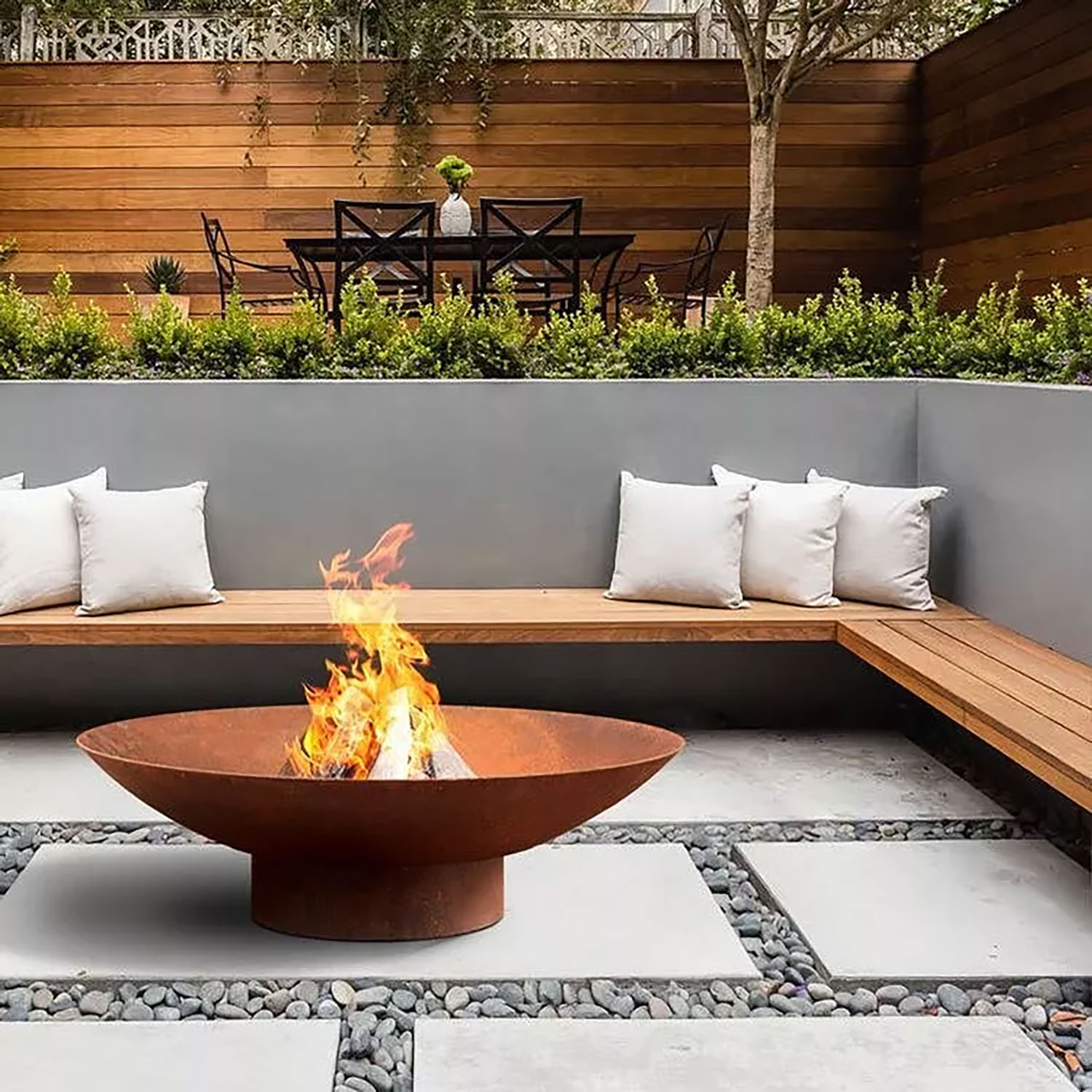
The first character is the patio designed around evenings with six to twelve adults. The floor plan starts from the conversation: how many people sit comfortably, where the food comes out, where the drink station lives, where the fire feature anchors the second half of the evening when the air cools.
A typical entertaining patio runs roughly 600 to 900 square feet of paver surface. The seating area sits at one end (a sectional and a coffee table sized for a real cocktail-and-appetizer setup, not the postage-stamp set the patio kit photos always use). The fire feature is at the conversational center, far enough back from the seating that legs are not too hot but close enough that the warmth carries.
The outdoor kitchen, when there is one, lives on the same wall as the door from the house so the cook is not crossing the entire patio with a tray of food. Counter depth matches the indoor kitchen. A small under-counter refrigerator handles the drink load. Storage for the platters, the long lighter, the cushion covers, and the things nobody knows where to put.
Lighting is layered. Path lights guide arrival. Downlights from the pergola handle the cook area. Warm low-voltage uplighting in the bed planting reads after dark. By 9 p.m. on a Saturday in October, the patio is the room the evening is happening in. That is how we design it.
The Tuesday-Through-Sunday Living Patio
The second character is the patio designed for a household that uses outdoor space every day from May through October. Different from the entertaining patio, which gets eight major nights a year and many quiet ones. This is the patio where the family eats dinner three nights a week, where the morning coffee gets read, where the kids run between the patio and the lawn after school.
The floor plan looks different from the entertaining patio. The patio sits closer to the kitchen door because most uses are quick (a coffee out, a phone call outside, dinner). The seating is sized for the household plus two (a six-top dining table, a smaller conversational seating area) rather than for the maximum entertaining load.
Shade matters more than at the entertaining patio because the patio gets used in afternoons, when summer sun comes hard. A pergola or shade structure becomes essential, not optional. Material choices lean toward textures that read warm in morning light and survive twenty years of furniture-dragging and kid-traffic without showing it.
Plant softening is heavier. Beds wrap the patio so the patio reads as part of the garden, not as a slab inserted into the lawn. Lighting is gentler. The patio is built for a calm domestic rhythm, not a performance evening.

The Multi-Level Walkout-Basement Patio
The third character is the patio shaped by terrain rather than by use case. Walkout-basement properties have a door at the lower level (basement or garden level) and another door at the main level (kitchen or great room), with grade that drops from one to the other.
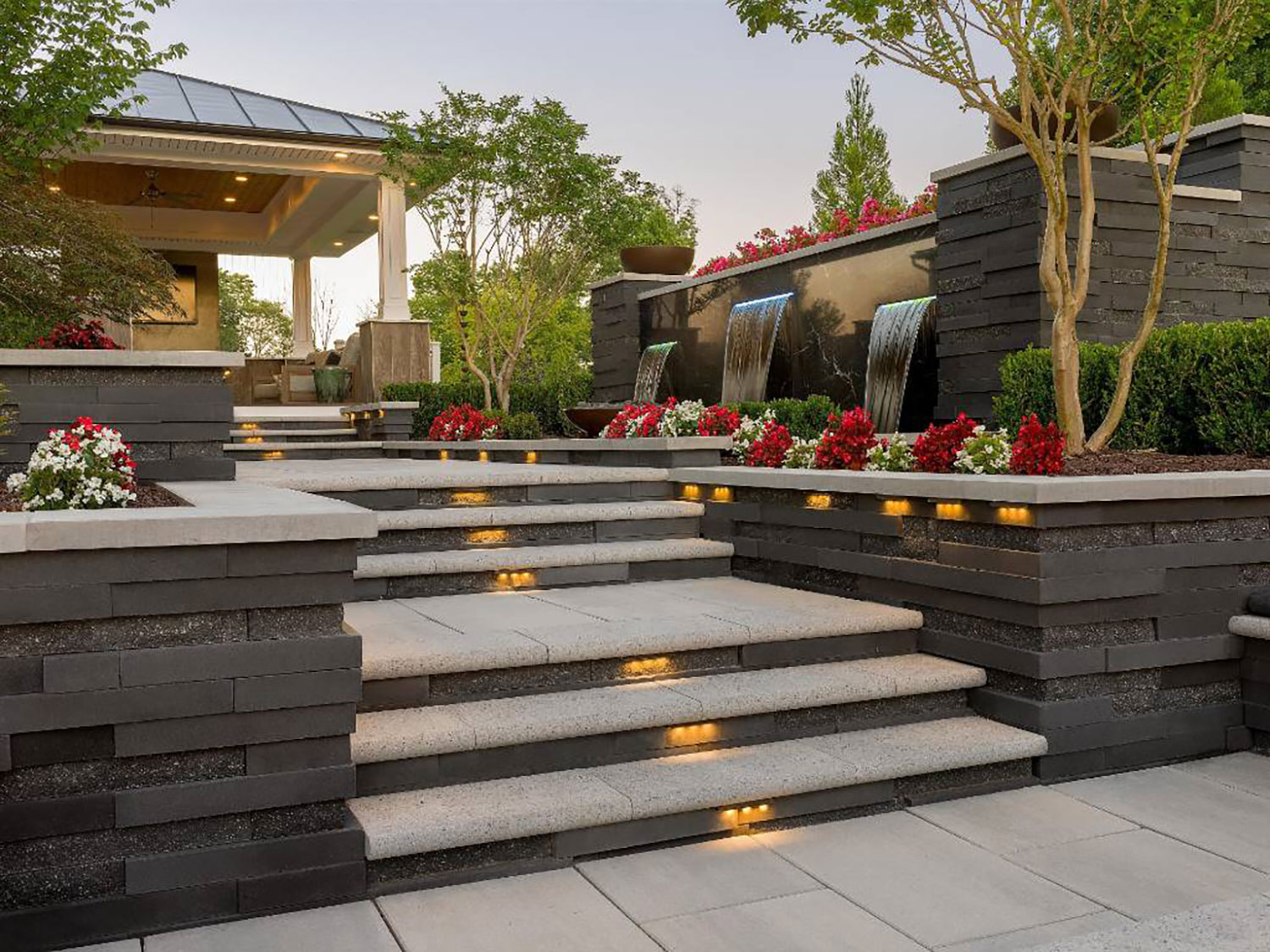
A multi-level patio handles both doors with separate but connected paver surfaces. The upper level extends from the kitchen door at the elevation the indoor floor reads at. The lower level extends from the basement door at the elevation the yard reads at. Stone steps or a wall-flanked grade transition connects the two. Done well, the two levels feel like one room with a step in the middle, not like two patios stitched together.
The design conversation has to handle drainage carefully. Water moving from the upper patio cannot end up at the basement door. Slope, grading away from the house, and base drainage all get worked into the plan from the first sketch. The retaining or terracing structures get specced for the soil and the freeze-thaw cycle, not for a calmer climate.
Walkout patios are some of the most architecturally satisfying projects we design because the grade gives the property a built-in vertical dimension most lots do not have. The patio reads as integral to the house in a way that a flat-lot patio rarely does.
What Every Patio We Design Has in Common
Three things stay constant across every patio character above.
First, the design starts from a property walk. We do not draw a patio before walking the house, the doors, the views, the grade, and the way the existing yard reads. Josh Perkins leads that walk and brings the design back. A patio drawn from a satellite image is the patio that does not feel right when it is built.
Second, the base preparation is built for Indiana, not for the spec sheet from a milder climate. Forty freeze-thaw cycles a year is what destroys patios that were not built for here. The base goes deeper than warm-climate jobs call for. The joint material is chosen for what holds up here. The edge restraint is designed to keep the patio’s edges from migrating after the third winter. This is the part of patio work that out-of-state firms get wrong and that homeowners find out about three years in.
Third, the patio gets integrated into the larger property design. The planting framework softens the edges. The lighting connects from house lights to landscape lights to the patio without a visible transition. The hardscape (the patio itself, the steps, the walls if any, the connecting walkways) reads as one continuous design, not as separate small projects bolted onto the yard.
Those three disciplines are what separate a patio that reads like a custom design from a patio that reads like a project kit. They are also what we built Plant Studio Landscape’s reputation on.

Frequently Asked Questions
What makes a patio a luxury patio rather than a standard one?
The difference is in the detail and the design integration. A luxury patio uses premium materials, natural stone or high-end pavers, with features like blended colors, banding, inlays, built-in seating, lighting, and seamless transitions to the rest of the landscape. At Plant Studio Landscape it is designed as part of the whole property rather than dropped in as a slab, so the patio relates to the planting, the grade, and the outdoor living areas around it. The luxury is in the craftsmanship and the coherence, not just the price of the stone.
How much does a luxury patio cost in the Muncie area?
Cost depends on size, material, and the complexity of the design, including features like walls, lighting, fire elements, and built-in seating. A luxury paver or natural-stone patio is a meaningful investment, well above a basic concrete pad, because the base work, material quality, and detailing are all higher. The honest answer for any East Central Indiana property comes from a site walk, where the grade, drainage, and access can be seen. You get a written proposal with the scope, materials, and number before any work begins.
What patio material holds up best over Indiana winters?
Concrete pavers and natural stone both perform well through East Central Indiana freeze and thaw when set on a properly excavated and compacted base, because the segmented surface flexes rather than cracking. The base depth and drainage matter more than the material choice; frost drives deep here, and a base that is too shallow will heave any surface. A luxury patio is built with the base sized for the local frost depth, which is what keeps the finished surface flat and tight for years rather than shifting after the first hard winter.
Can a patio be designed to work in all four seasons?
Yes, and in Indiana that is part of the point. A patio designed for year-round use pairs the paving with features that extend the season: a fire feature for cool spring and fall evenings, lighting so the space works after sunset, and layout and screening that account for sun and wind. Designed well, a luxury patio is not just a summer space but the reason the yard keeps getting used from the first warm week of spring through the last bonfire of fall.
How long does a luxury patio installation take?
A high-detail patio takes longer than a basic slab because the base work, material setting, and detailing are more involved, and the project is often combined with walls, lighting, or planting that are built in sequence. The exact timeline depends on size, access, and weather. Because Plant Studio builds with its own crews, the same team is on site start to finish, you get weekly updates on progress, and there is one point of contact for any question rather than a general contractor coordinating subs.
Schedule a Patio Design Consultation
Because how you live outside matters, the patio has to work for the way you actually use it, not the way it photographs. Request a quote and we will walk your property, ask how you would actually use the patio, talk through which of the three characters fits your house and your life, and put together a design that holds up for the next twenty Indiana winters. The walk is free and there is no obligation after it.